.webp)
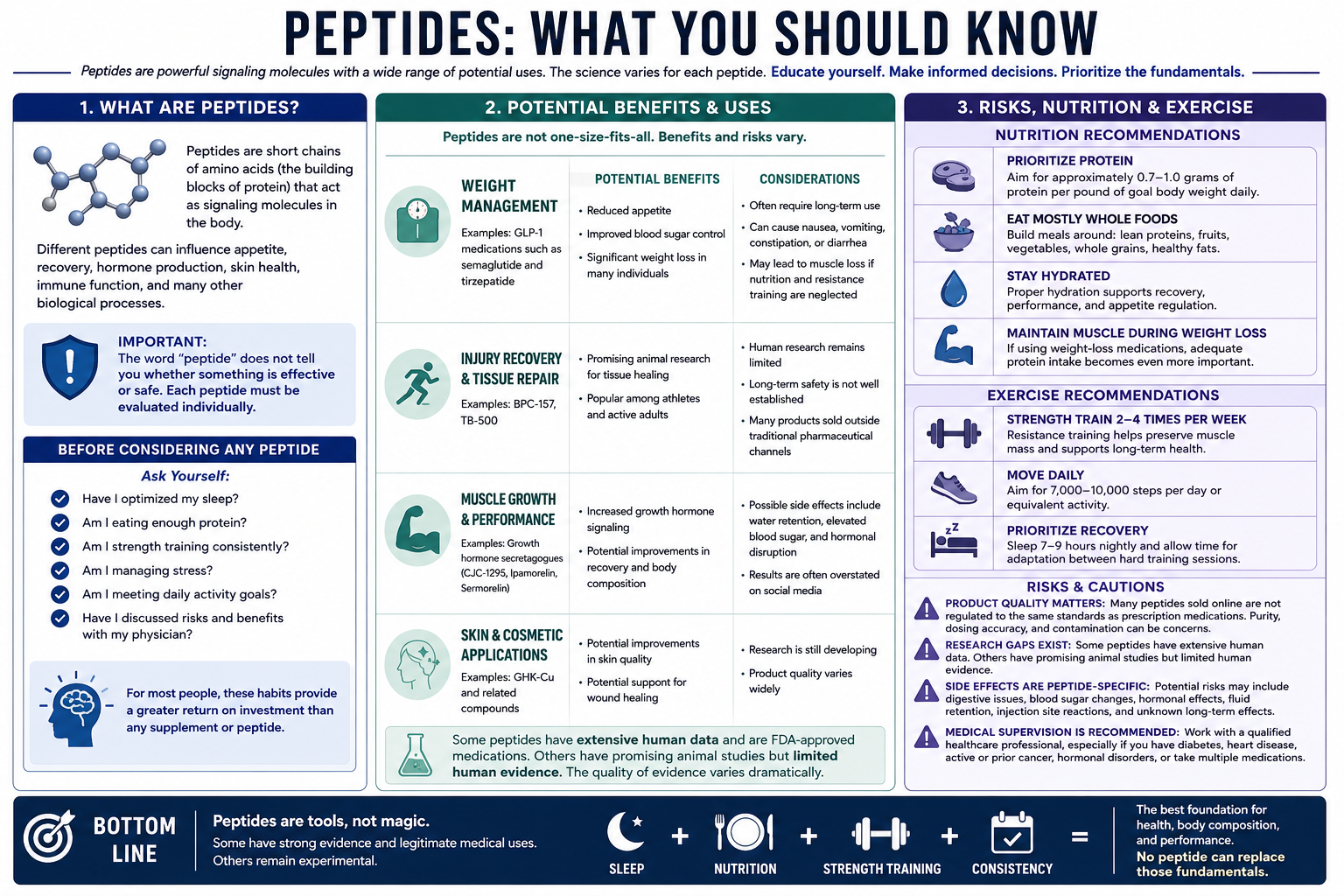
Peptides have become one of the biggest conversations in health, weight loss, recovery, and performance.
Maybe you're taking a GLP-1 medication to help with weight loss. Maybe you've heard about peptides being used for injury recovery or body composition. Or maybe you're simply curious because friends, social media, podcasts, and wellness clinics seem to be talking about them everywhere.
There's an important point that can easily get lost in all of that conversation. Whether you use peptides or not, nutrition and exercise still matter.
In fact, if you're investing your time, money, and effort into a medication or peptide therapy, dialing in your nutrition, strength training, sleep, and recovery may help you get more out of that investment while supporting your long-term health.
What Exactly Is a Peptide?
Peptides are short chains of amino acids that act as signaling molecules throughout the body. Your body naturally produces many different peptides, and they're involved in processes ranging from appetite and metabolism to hormone signaling and tissue repair.
But "peptide" is a very broad category, and this is where the conversation often gets oversimplified.
Some peptide-based medications have gone through extensive clinical research and are FDA-approved for specific medical conditions. Others have far less human research behind them and may be sold or used for purposes that haven't been established as safe or effective. That's why we shouldn't lump every peptide into the same category.
The question shouldn't simply be, "Do peptides work?" Better questions are more specific. Which peptide? For what purpose? What does the research show? What are the potential risks? And is it appropriate for this individual?
Those are conversations worth having with a qualified healthcare provider, not something to decide based on something you heard or saw on social media last week.
Peptides Can Be a Tool
There sometimes seems to be a tendency in the fitness world to divide people into two camps.
One side sees medications and peptides as shortcuts that undermine "real" work. The other sees them as the solution that finally makes nutrition and exercise less important. Neither perspective is particularly helpful.
A better way to think about them is as tools. If a physician determines that a medication is appropriate for you, using that tool doesn't diminish the work you're doing to improve your health. At the same time, the existence of that tool doesn't eliminate the need to take care of your body.
This becomes especially important when we're talking about weight loss.
Losing Weight and Losing Fat Aren't Exactly the Same Thing
When most people say they want to lose weight, what they usually mean is that they want to lose body fat. Ideally, we want to reduce excess body fat while preserving as much lean mass as possible.
During any significant period of weight loss, however, some lean tissue can be lost along with fat. Research consistently shows that when weight comes off quickly, particularly with appetite-suppressing medications, a meaningful portion (sometimes 20-40%) can come from muscle rather than fat. That makes preserving muscle an important part of any well-designed weight-management program.
This is where nutrition and exercise become especially valuable.
If you're using a medication that substantially reduces your appetite, eating less may suddenly become easy. Eating enough of the right things can become the bigger challenge. Simply eating as little as possible isn't the goal. We want to lose weight while continuing to give the body the nutrition and training stimulus it needs to maintain muscle, function well, and support long-term health.
Protein Becomes a Priority
If your appetite decreases, protein-rich foods should become one of the priorities on your plate.
Protein provides amino acids your body uses to maintain and repair muscle tissue. It also contributes to satiety and provides important nutrients depending on the foods you choose. Good options include chicken, turkey, lean beef, pork, and fish; eggs; Greek yogurt and cottage cheese; milk and other dairy products; beans and lentils; tofu and other soy foods; and protein shakes when whole-food options aren't practical.
Your individual protein needs depend on factors including body size, age, activity level, training, health status, and goals. Rather than trying to make every meal perfect, start with something simple. Build each meal around a quality source of protein.
If you're struggling to eat enough because your appetite has changed significantly, that's also a good reason to talk with a Registered Dietitian.
Strength Training Matters Too
Protein provides the building blocks. Resistance training gives your body a reason to keep the muscle.
Strength training isn't just for bodybuilders or competitive athletes. Maintaining muscle and strength supports everyday function, metabolic health, physical independence, and healthy aging. Without a strength training stimulus, your body has no reason to hold onto muscle mass, especially in a calorie deficit.
You also don't have to spend two hours in a gym every day. For many adults, a few well-designed resistance-training sessions each week can provide a meaningful stimulus. Squatting, pushing, pulling, hinging, carrying, and lifting appropriately for your current ability can all be part of that plan.
And if you've never exercised before, that's okay. You don't need to "get in shape" before starting. A good coach should meet you where you are and gradually progress your training as your fitness improves.
Don't Forget Carbohydrates
When people begin trying to lose weight, carbohydrates are often the first thing they eliminate. But if you're exercising, carbohydrates can be extremely useful.
Carbohydrates provide fuel for higher-intensity activity and support your ability to train effectively. Fruits, vegetables, potatoes, rice, oats, whole grains, beans, and other carbohydrate-rich foods can absolutely be part of a healthy weight-management plan.
Instead of asking, "How can I eliminate carbs?" try asking, "How can I use carbohydrates to support my activity and training?"
Hydration, Sleep, and Recovery Still Count
Nutrition and training get most of the attention, but don't overlook the basics.
Stay adequately hydrated, especially if changes in appetite also cause you to drink less throughout the day. Aim for consistent, adequate sleep. Give yourself time to recover between difficult workouts.
And remember that more isn't always better. The goal isn't to combine medication with an extremely restrictive diet and an exhausting exercise program in an attempt to lose weight as quickly as possible. The goal is to create an approach you can actually sustain.
Be Careful Where Your Peptides Come From
There's another important distinction in this conversation.
A prescription medication obtained through an appropriately licensed healthcare professional and pharmacy isn't necessarily equivalent to a product purchased online and labeled "for research use." Product purity, dosing accuracy, contamination, sterility, and long-term safety can all become concerns depending on the compound and its source.
Research also varies tremendously between peptides. Some have extensive human clinical trials. Others have promising animal research but relatively little quality human evidence.
If you're considering one, ask questions. What evidence supports its use? Is it FDA-approved for what it's being prescribed for? What are the known side effects? What don't we know yet? Could it interact with my medications or health conditions? Where is the product coming from? And who is monitoring me while I'm taking it?
Being interested in peptides doesn't mean you have to be afraid of them. It means you should be an informed consumer.
Build the Foundation Around the Tool
If you're currently using peptides or another medication as part of your health journey, we want to help you get the most out of the opportunity you have.
Think of it this way: medication or peptide therapy may be one tool. Nutrition, strength training, sleep, recovery, and consistency are the foundation supporting it. If the tool eventually changes or goes away, we want that foundation to remain.
That's how we approach health and fitness at Longma Fitness.
We're not interested in telling everyone they need to follow the exact same path. We're interested in helping people become stronger, healthier, more capable, and more confident in taking care of themselves.
Whether you're currently taking a peptide, considering one, or have no interest in them at all, the fundamentals remain remarkably similar. Eat enough quality food. Prioritize protein. Strength train. Move your body. Sleep. Recover. And keep showing up.
Those habits aren't particularly flashy. But they're still some of the most powerful tools we have.
🎯 Free 10-Minute Discovery Call
If you'd like help figuring out what nutrition and exercise should look like for you, schedule a complimentary 10-minute discovery call where we'll discuss your goals, where you are now, and what your next step could look like.
No pressure, no commitment, just a quick conversation to see if we can help.

.jpg)


